


Duntulm Dinosaur Hunt and the Falls of Rha 6th Feb
- Karen Partridge
- Feb 7, 2020
- 4 min read
We toyed with whether or not to go and capture the Sunrise, as we were already up and about, but decided to just have a leisurely breakfast and do a few chores instead before heading back to Score Bay in search of the elusive dinosaur prints we couldn’t find yesterday. But Google is your friend! I managed to get some information including some photos different paleontologists had posted - so we at least knew what we were looking for this time.

The low tide was just before 11.00am and I had planned to go along to a craft group in Broadford at 1.30pm called Ewe Time today, but given the tide I realised that would have to wait until next week (its about a 2 hour drive down there and I didn’t want to rush my dinosaur hunting).

Although the vast majority of Skye is composed of fossil-free basalt rocks, there are exposures of sedimentary beds in several places around the coasts. Many of these exposures are difficult to reach, and many of them are rich in fossils. For many people the most attractive of Skye's sites are the ones with evidence of dinosaurs, Duntulum (2015), Staffin (An Corran 2002) and Brother’s Point (Rubha nam Brathairean 2018). Visitors are welcome to come and see them but any collecting of fossils, or damage to fossils or prints at any of these sites can lead to a fine of up to 40,000 GBP.

At Score Bay, (Cairidh Ghlumaig, Duntulum Formation, Bathonian) we made our way down the steep embankment and across the mine-field of ankle breaking boulders and ball-bearing rocks to reach the outcrops of sandstone now visible with the tide out.

We looked first at beds 34 & 35 from a Middle Jurrassic lagoon which is a designated Geological Conservation Review Site according to the information we found on Google. About the geology of the beds, their age is Bathonian (Middle Jurassic, 168-166 Ma). Beds 9 and 35 are littoral, while bed 34 is a deeper marine facies that was temporarily shallower. All the sauropods (and one unknown ornithischian (bird hipped dinosaur such as Triceratops) from bed 9b) were walking in the water at the time the footprints were made, and at no point were the prints exposed to air before fossilisation. The scientist can tell because of the lack of cracking or other features that emerge when mud dries up.
The Middle Jurassic was a dynamic time in dinosaur evolution, but the dinosaur fossil record from this time is extremely rare all over the world. However, the Isle of Skye preserves marginal marine and terrestrial deposits of Middle Jurassic age, sparse bones, teeth, footprints and small segments of dinosaur trackways have been found (about 170 million years old).
The coastal outcrop of the Duntulm Formation (Bathonian) at Cairidh Ghlumaig, has the most extensive dinosaur fossil site yet known in Scotland, and preserves numerous trackways of sauropod dinosaurs in multiple layers deposited in a lagoonal system. Scientists believe these tracks as most likely belonging to a primitive, non-neosauropod species that retained a large claw on manual digit 1 and produced narrow-gauge trackways. They provide additional evidence that basal sauropods persisted deep into the Middle Jurassic, a time when the earliest members of larger and more derived sauropod lineages were developing. The tracks document multiple generations of sauropods living within the lagoonal environments of Jurassic Scotland, and along with other tracks found over the past two decades, suggest that sauropods may have frequented such environments, contrary to their image as land-bound dinosaurs.


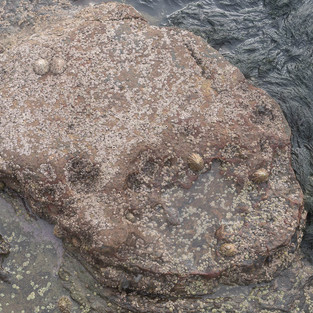


With the help of Vince’s iPhone to show us the photographs for comparison, we located the convex hyporelief (sticking up) dino prints first closer to the shoreline and on the West side of the rockbed. Then we explored some more and found the concave epirelief (imprinted downwards) ones further to the North of the bed and over to the Eastern sided of the rock bed - we were soooooo excited. You could clearly see the narrow gauge trackways. It was like walking in ancient times! Vince left me to play with photographing them whilst he went to fetch the drone.


When we finished with the Saurapod prints and trackways, we went over to bed 9b in search of a tridactyl footprint (the unknown ornithischian) we had seen on the internet, but we couldn’t find it.
We spent the good part of 2 hours there and really enjoyed ourselves. Vince took a couple of YaYa Vlogs (15 & 16) as well, and also some great drone footage.
We went home and had lunch - more of my homemade Scotch Broth soup. Then we popped down to Uig to Rankins for some bread rolls (we plan to take soup and rolls tomorrow for lunch out to Rhubna Hunish tomorrow). We got some Glenfiddich and some Ledaig Scotch as we had run out, as well as the bread rolls.


As it was a dry day for a change we stopped in at the Falls of Rha to take some more photos making the most of the weather. It was such a magical place, with lots of interesting plant life, lichen, toadstools and such. But the wet environment makes it a bit slippery in places, and unfortunately coming up and embankment my right leg slipped and my left leg had to brace against falling so it is now quite painful.


I was soon snapping more photos, including a Sea Eagle we spotted, although it was very high up so the resolutions not great - I was still happy to get a shot of this “Plank in the Sky”.
We had a bit of a sheep block on the road out of Uig towards Duntulum

Vince also dropped me off briefly to take a few shots of the Linicro Tups.


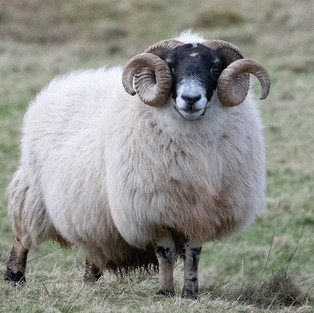


As we came back to Willie McLeod’s I took a few shots of the farm animals I see each day - some of Alan’s sheep dogs waiting for him to come in from the field with his tractor, and his new Rooster for the Hens.


Back at home we had my homemade Lentil Soup and bread rolls for dinner and watched the last part of “Gold” on DVD.


Comments